TTIP: Lobbyparadies auch für den Wasserkonzern Veolia

CEO


TTIP: Lobbyparadies für Konzerne

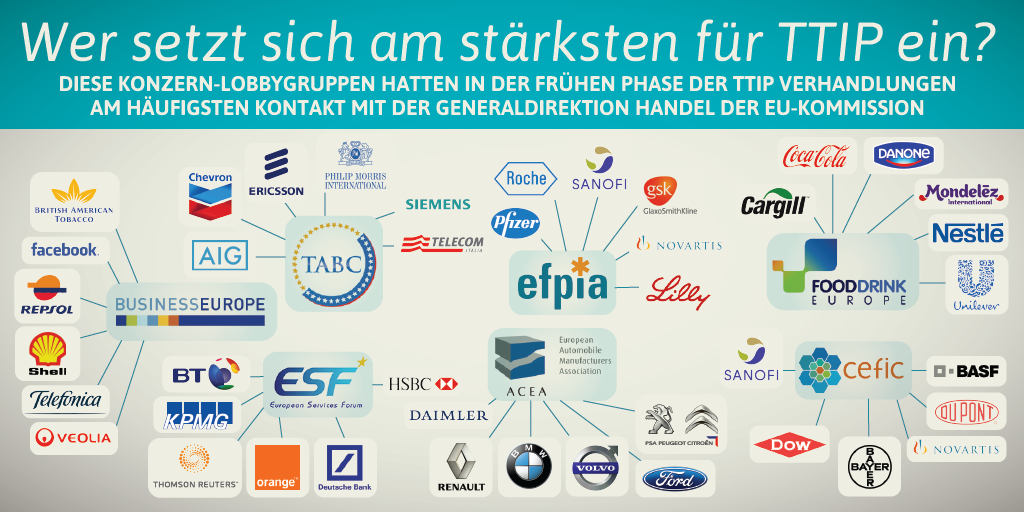
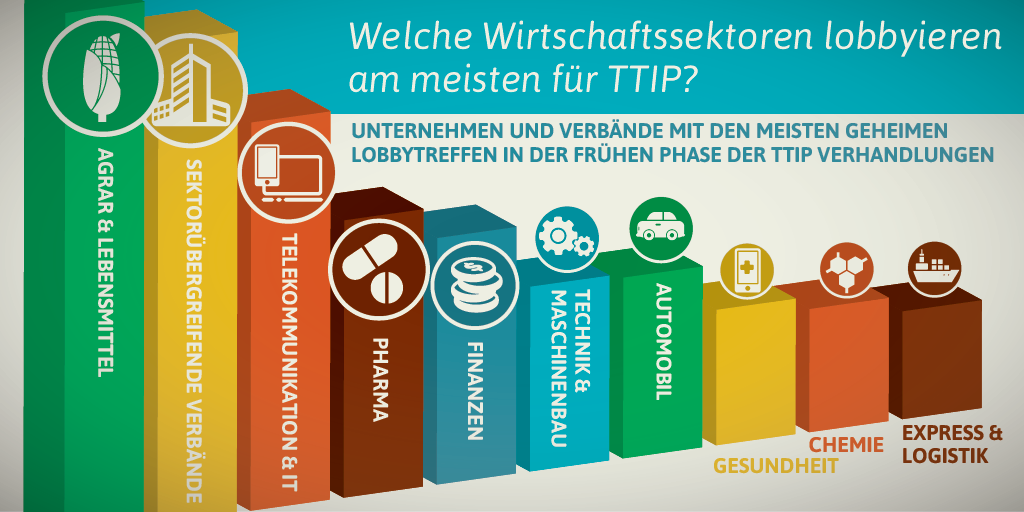
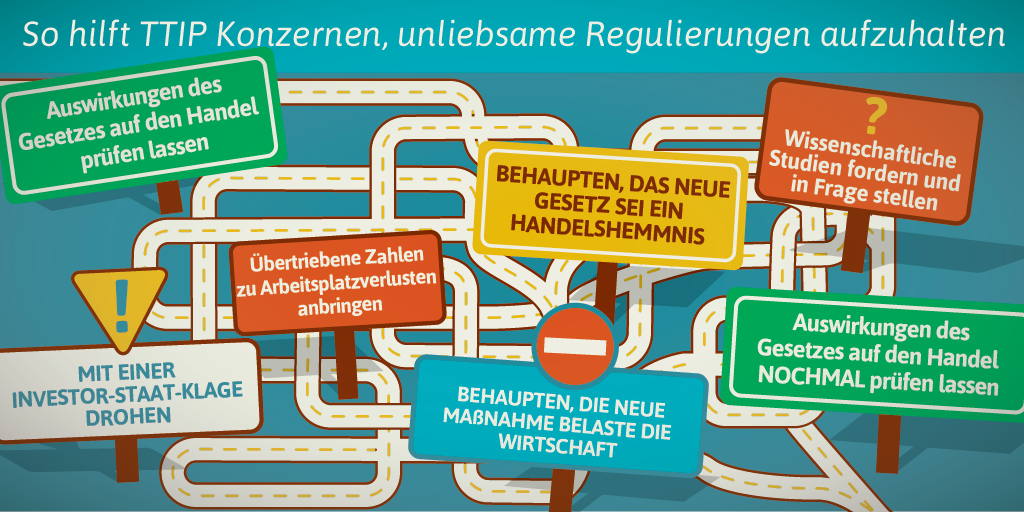
Welche Unternehmen drängen am meisten auf das geplante EU-USA Handelsabkommen TTIP? Wer beeinflusst die Verhandlungsposition der EU? Acht neue Infographiken von Corporate Europe Observatory bringen Licht in die Konzern-Lobby hinter TTIP.
Für den Berliner Wassertisch nicht weiter überraschend, setzt sich auch der „Umwelt“konzern Veolia stark für TTIP ein.
Pressemitteilung von CEO:
TTIP: a corporate lobbying paradise – the seven key findings:

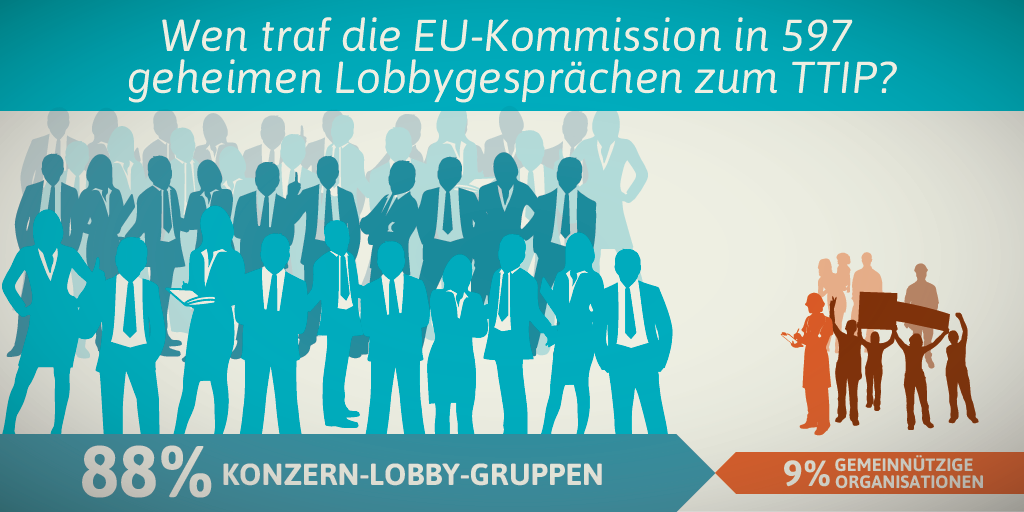
* In the early phases of the TTIP negotiations (January 2012 – February 2014), DG Trade had 597 behind-closed door meetings with lobbyists to discuss the negotiations. 528 of those meetings (88%) were with business lobbyists while only 53 (9%) were with public interest groups. So, for every meeting with a trade union or consumer group, there were 10 with companies and industry federations.


* This pattern hasn’t changed significantly since the new Commission took office in November 2014. In the first six months of the job, Cecilia Malmström, members of her Cabinet and the director general of DG Trade had 122 one-on-one lobby meetings behind-closed doors in which TTIP was discussed. 100 of these meetings were with business lobbyists – but only 22 with public interest groups. So, for every meeting with a trade union or a consumer organisation, Malmström and her staff had 5 get-togethers with companies and their lobby groups.
* The corporate lobby groups which lobbied hardest for TTIP in the early phases of the negotiations are: the European employers‘ federation BusinessEurope, the Transatlantic Business Council (representing over 70 EU and US-based multinationals), the European car lobby ACEA, the chemical lobby CEFIC, the European Services Forum, the European pharmaceutical lobby EFPIA, Food and Drink Europe, the US Chamber of Commerce and Digital Europe (whose members include all the big IT names, like Apple, Blackberry, IBM, and Microsoft).
* These business sectors have lobbied most for TTIP in the early phases of the negotiations: agribusiness and food, cross-sectoral lobby groups such as BusinessEurope, telecom & IT, pharmaceuticals, finance, engineering & machinery, automobiles, health technology, chemicals, express & logistics.
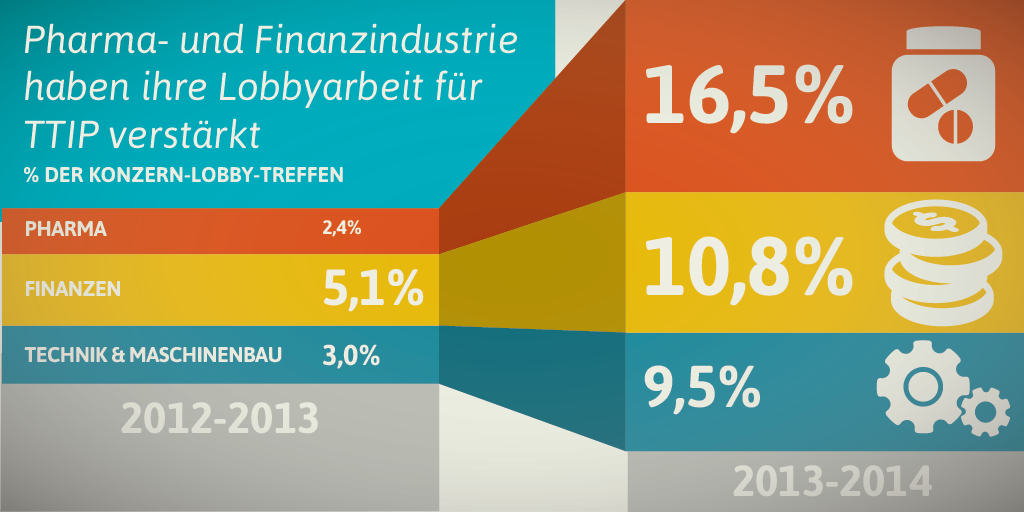
* Several sectors have significantly stepped up their lobbying for TTIP (comparing the preparatory phase of the negotiations with the first months): the pharmaceutical sector has increased its lobbying for TTIP seven-fold. While only 2,4% of DG Trade’s one-on-one lobby meetings on TTIP were with Big Pharma in the early phases of the negotiations (January 2012 to March 2013), the sector’s share in lobby meetings jumped to 16,5% in the period after (April 2013 to February 2014). The engineering and machinery sector has tripled its TTIP lobbying effort in the same period (from 3,0% to 9,5% of the behind-closed-doors meetings with DG Trade). Financial sector lobbying also doubled (from an 5,1% share in the total amount of corporate lobby meetings on TTIP to 10,8%).
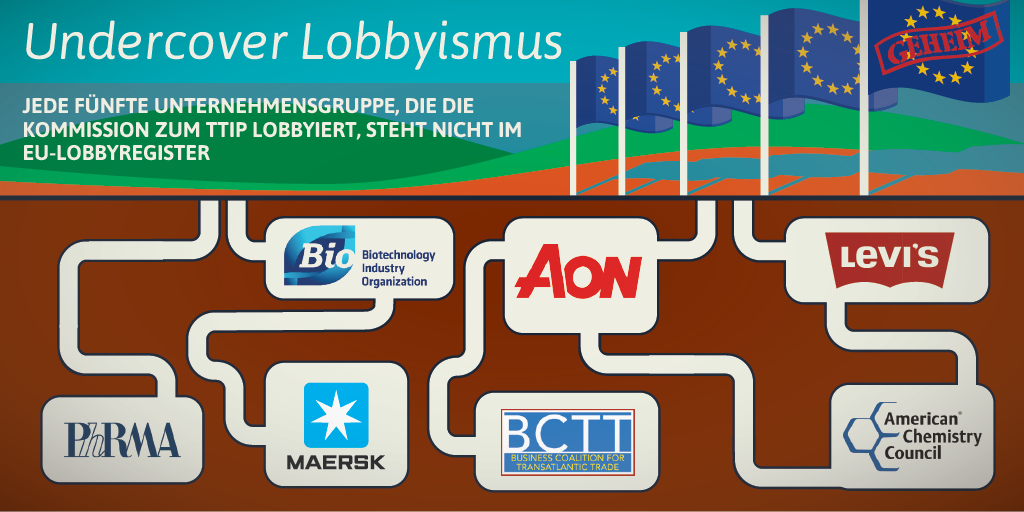
* One in every 5 corporate lobby groups which have lobbied DG Trade on TTIP are not registered in the EU’s Transparency Register, amongst them large companies such as Maersk, AON, and Levi’s. Industry associations such as biotechnology lobby BIO, pharmaceutical lobby group PhrMA and the American Chemical Council are also lobbying under the radar. More than one third of all US companies and associations which have lobbied DG Trade on TTIP are not in the EU register.
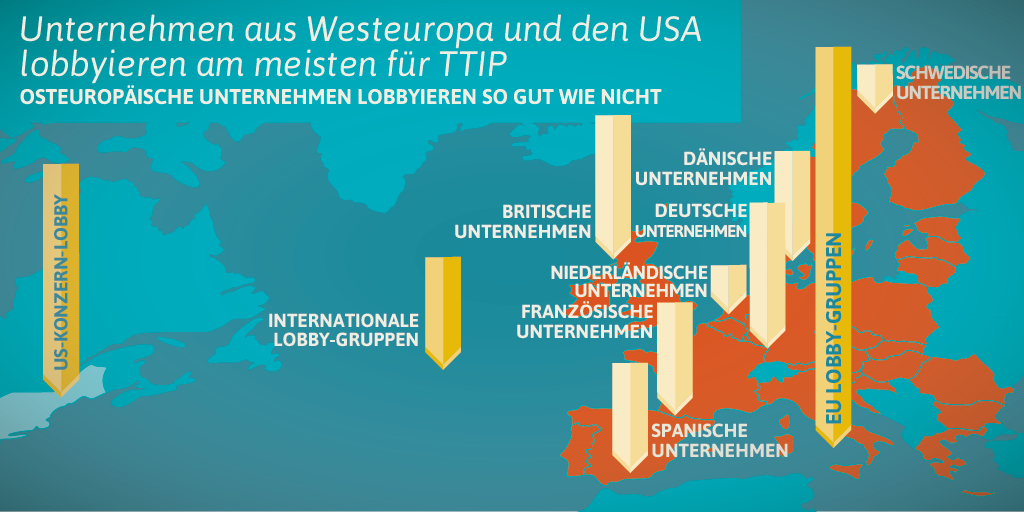
* TTIP lobbying comes mostly from business in Western Europe and the US. Between January 2012 and February 2014 not a single direct lobby encounter took place on TTIP between DG Trade and businesses from Greece, Cyprus, Malta, Portugal and most of Eastern Europe (Poland, Bulgaria, Hungary, Czech Republic, Slovenia, Estonia, Lithuania, Latvia).
* * * * * * * * * * *
P i a   E b e r h a r d t
Corporate Europe Observatory (CEO)
Cranachstraße 48
50733 Cologne
Germany

www.corporateeurope.org
Tel.: ++49 (0)221 789 678 10
Mobile: ++49 (0) 152 56 30 91 02
pia@corporateeurope.org
skype: piaebse

Sign up to the CEO e-newsletter: http://www.corporateeurope.org/subscribe-our-newsletter
TTIP und der Brüsseler Lobbyismus

RBB, Funkhaus Europa

Interview – Pia Eberhardt TTIP und der Brüsseler Lobbyismus

In Brüssel regieren die Bürokraten, so die gängige Auffassung. Aber im Hintergrund mischen noch andere einflussreiche Kräfte mit: Lobbyisten. Interview mit Pia Eberhardt von Corporate Europe Observatory (CEO), eine Gruppe, die über die politische Macht von Konzernen und Lobbyisten informiert.

Zwischen 15.000 bis 30.000 Angestellte sollen in Brüssel für die unterschiedlichsten Ziele Lobby machen. Damit kämen umgerechnet auf jeden Abgeordneten 20-40 Lobbyisten. Nach Washington D.C. ist Brüssel damit der zweitgrößte Tummelplatz der Welt für Lobbyisten aller Couleur.

Zum Beitrag, zum Interview (Audiobeitrag)

European Commission opening back door to fracking

15 April 2015

Fracking companies are dominating the behind-the-scenes agenda on EU fracking policies, investigation by Friends of the Earth Europe and Corporate Europe Observatory shows today.

The promotion and expansion of controversial fracking [1] in Europe appears to have become the core aim of an advisory network set up by the European Commission last year. The body was supposed to assess on-going fracking projects and the safety and appropriateness in Europe of different technologies.

Friends of the Earth Europe had originally joined the expert network to highlight the dangers of shale gas development to citizens and the environment. After it became apparent that the pro-shale gas agenda is controlling the group, Friends of the Earth Europe has decided to walk out.

Antoine Simon, shale gas campaigner at Friends of the Earth Europe said: „While a ’science and technology network‘ on unconventional fossil fuels sounds objective, it’s a complete façade. The European Commission is giving the fracking industry all the seats at the top table and crowding out citizens and groups with legitimate concerns about this dirty industry.“

A look at who’s who in the advisory network paints a worrying picture of the dirty energy dominance of the Commission’s shale gas policy. Of members who are not employed by the European Commission:

Pascoe Sabido, researcher and campaigner at Corporate Europe Observatory said „While the Commission is crowing from the rooftops about its climate ambitions as we get closer to crucial climate talks in Paris, its cosy relationship with the fossil fuel industry ensures fracking is being ushered in through the back door. This not only smacks of hypocrisy, but it ignores the millions calling for an end to fracking and for fossil fuels to be left in the ground. But this case is not a one off. Privileged access for dirty industry is endemic among the Commission’s advisory groups. Hopefully the European Ombudsman’s on-going investigation should be enough of a wake-up call to fix the problem once and for all.“[2]

With the fracking industry already responsible for substantial environmental damage around the world and widespread public opposition to it across Europe, it is deeply concerning that the fracking industry has such a dominant position in evaluating its own performance. Friends of the Earth Europe and Corporate Europe Observatory are calling for this new advisory network to be recognised as a front for industry lobbying and therefore scrapped.

***

Notes:
[1] High-volume horizontal hydraulic fracturing or ‚fracking‘ involves using a combination of technologies for extracting unconventional fossil fuels such as shale gas, tight gas, shale oil and coal bed methane. It requires a pressurised liquid composed of water, sand, and chemicals. It has disastrous consequences for public health and the environment – such as water contamination and air pollution – and can even trigger earthquakes. A growing body of science suggests that the impact of shale gas production and consumption could have a climate impact comparable to the most polluting fossil fuels, such as coal.

[2] The European Ombudsman reviewed the European Commission advisory group policy and found it deeply inadequate. She has, among other things, recommended legally binding rules across all advisory groups in all directorates general, which the Commission has until 30th April 2015 to respond to.


Die Lobby-Vereinigung EFILA und ihr Einsatz für Investment-Schiedsgerichtsverfahren

Bildschirmfoto 2015-04-14 um 14.47.12

Transnational Institute
15.04.2015

Anwälte untergraben die öffentlichen Interessen
Die Lobby-Vereinigung EFILA und ihr Einsatz für Investment­Schiedsgerichtsverfahren

Lobby group EFILA’s stake in investment arbitration
von Cecilia Olivet, Pietje Vervest, Pia Eberhardt, Fabian Flues

Die öffentliche Debatte um die ISDS Schiedsgerichtsverfahren ist an Firmenanwälten und Anwaltssozietäten nicht spurlos vorübergegangen. Als Reaktion auf die umfangreiche öffentliche Kritik am ISDS-Mechanismus haben kürzlich eine Reihe von Rechtsanwaltsfirmen einen Think Tank gegründet, um das gegenwärtige ISDS System zu verteidigen: Die Europäische Vereinigung für Investment-Recht und -Schiedsgerichte. (European Federation for Investment Law and Arbitration: EFILA, Gründungskonferenz am 23.01.2015 in London)

EFILAs erklärtes Ziel ist es, „eine objektive Debatte“ über ISDS zu unterstützen. Die Anwaltskanzleien und Personen im Vorstand von EFILA vertreten jedoch klare eigennützige Interessen in Bezug auf das augenblickliche Investment-Schiedsgerichts-System. Das weckt ernsthafte Zweifel daran, ob ihre Empfehlungen an die Politik mehr sind als reine Propaganda im Interesse der Schiedsgerichts-Industrie.

In response to growing public criticism of international investment law, a new lobby group has emerged, EFILA, seeking to influence European officials. This briefing exposes how EFILA represents an attempt by the arbitration industry to fend off much-needed reforms in order to protect a highly lucrative business.

zur pdf (in englischer Sprache)


Interview mit Pia Eberhardt zu TTIP: „Den politischen Preis in die Höhe treiben“

CARTA
29.3.2015

Interview von Eric Bonse mit Pia Eberhardt (CE)

Trotz massiver öffentlicher Kritik am geplanten Freihandelsabkommen ist die EU keinen Millimeter von ihrer neoliberalen Agenda abgerückt, sagt Pia Eberhardt von der lobbykritischen NGO „Corporate Europe Observatory“ im Interview mit Eric Bonse. Stattdessen wirft Brüssel die Propagandamaschine an.
CEO

Zum Interview

Pia Eberhardt zu den Gefahren von TTIP: „Was einmal in privater Hand ist, kann nicht mehr re-kommunalisiert werden“

DER FREITAG
3.3.2015

Jonas Weyrosta, Felix Werdermann: Interview. Pia Eberhardt (Corporate Europe Observatory, CEO) kämpft gegen das Handelsabkommen zwischen EU und USA. Obwohl sie eigentlich nichts gegen internationalen Handel hat.

Ausschnitt:
Stop TTIP Stop CETAFrage: „Was spricht denn gegen TTIP, was ändert sich für die Menschen in Europa?“
Eberhardt: „Im Lebensmittelbereich sollen Schutzstandards abgebaut werden. Auch demokratische Handlungsspielräume werden eingeschränkt. Wenn ich mich als Bürger einer Stadt dafür einsetze, dass die Wasserwerke wieder in die öffentliche Hand gelangen, kann TTIP das verhindern. Was einmal in privater Hand ist, kann nicht mehr re-kommunalisiert werden. Das ist die Idee hinter internationalen Handelsabkommen.“

Zum Artikel